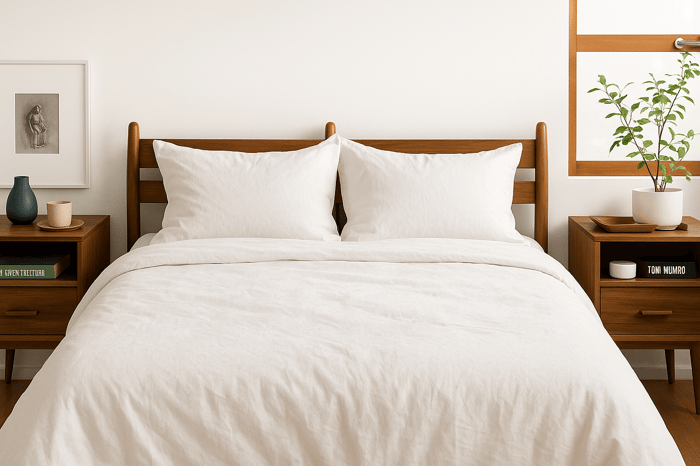


You fell asleep fine. By 3am you're kicking off the covers, damp and wide awake.
This is the pattern most hot sleepers and people dealing with night sweats experience — even in a cool room.
Here’s what actually happened: moisture vapor your body releases all night had nowhere to go. It built up under the covers, raised humidity against your skin, and your body responded the only way it knows how — by sweating to cool itself down.
This isn’t a you problem. It’s a bedding materials problem.
If your bedding is trapping heat and humidity, switching to a wool comforter for hot sleepers can completely change how your body regulates temperature overnight.
Most bedding insulates. It traps warmth and feels comfortable at 10pm. But it has no mechanism for releasing moisture vapor. Once humidity builds, the microclimate under your covers destabilizes — and that’s when the 3am wake-up happens.
This is also why most “cooling bedding” fails. It may feel cool at first, but it doesn’t manage humidity over time. For people experiencing night sweats, overheating, or menopause-related temperature swings, that distinction is everything.
Wool works differently — not because of a coating or treatment, but because of what the fiber actually is.
If you want to understand why most “cooling” products fail, see our guide to breathable bedding for night sweats, where we break down airflow vs true moisture control.
The 10-Second Verdict: Why Wool Works for Night Sweats and Hot Sleepers
Wool is the only bedding material that actively regulates both heat and moisture at the same time.
That’s why it consistently outperforms alternatives for:
night sweats
hot sleepers
menopause-related overheating
Instead of trapping humidity like synthetics or holding dampness like cotton, wool stabilizes the sleep microclimate — preventing the heat spikes that wake you up.
Why Thermoregulation Matters for Night Sweats and Overheating
The body regulates temperature continuously during sleep. Core temperature drops, heat is released through the skin, and moisture vapor is produced — even if you’re not visibly sweating.
The space between your body and your bedding — known as the sleep microclimate — determines whether that process works or fails.
When bedding traps heat or humidity:
skin temperature rises
humidity builds
sweating is triggered
sleep is disrupted
This is the underlying mechanism behind:
waking up sweaty
overheating in a cold room
disrupted sleep cycles
If you’re trying to pinpoint the cause, this breakdown of why you wake up sweaty explains how bedding creates the heat-and-humidity cycle most people miss.
For hot sleepers and those experiencing night sweats or menopause, even small increases in humidity can trigger this chain reaction.
Wool changes this outcome by stabilizing the microclimate instead of amplifying it.
This is the core reason wool thermoregulation is so effective for night sweats and hot sleepers — it prevents humidity from building up in the first place.
How Wool Fiber Structure Regulates Heat and Moisture
Wool’s performance comes from its structure — not a finish or technology layer.
Keratin Core: Internal Moisture Absorption
Wool fibers are made of keratin, which allows them to absorb moisture vapor into their core without feeling wet.
This prevents humidity from accumulating on the skin — where overheating begins.
Natural Crimp: Built-In Airflow and Breathability
Each wool fiber has a natural crimp that creates microscopic air pockets.
These pockets:
allow airflow
prevent heat buildup
reduce stagnant, humid air zones
This is what true breathable bedding looks like — not just airflow, but continuous air exchange.
Hygroscopic Behavior: Managing Vapor Before Sweat Starts
Wool can absorb up to 30–35% of its weight in moisture vapor.
Compare that to synthetics, which absorb almost nothing.
This means:
wool manages moisture before it becomes sweat
synthetics deal with it after overheating has already started
This difference is exactly why synthetic bedding often makes night sweats worse, while wool helps prevent them.
These structural properties are what allow wool to regulate both heat and moisture — the two main drivers of overheating during sleep.
Moisture Management: Why “Wicking” Isn’t Enough for Hot Sleepers
Most “cooling” bedding relies on wicking — moving liquid sweat across the surface.
But sweat is the end of the problem, not the beginning.
Wool: Vapor Absorption + Temperature Buffering
Wool absorbs vapor internally, triggering a small heat exchange that stabilizes temperature.
This reduces:
humidity spikes
overheating cycles
sweat production
Synthetics: Surface Cooling, Internal Heat Buildup
Synthetic materials:
repel moisture
trap humidity near the skin
increase heat retention over time
This creates the familiar cycle:
warm → humid → sweat → wake up
Which is why many people searching for a cooling comforter for hot sleepers still wake up overheated.
The issue isn’t surface temperature — it’s trapped moisture.
Because wool manages moisture before it turns into sweat, it directly reduces the conditions that cause night sweats.
Thermal Buffering: Why Wool Prevents Overheating Cycles
Wool doesn’t just manage moisture — it actively stabilizes temperature.
Latent Heat Exchange
When wool absorbs moisture, it releases heat.
When it releases moisture, it absorbs heat.
This creates a natural buffering system that:
smooths temperature spikes
reduces sudden overheating
prevents “too hot → too cold” cycles
Why This Matters for Menopause and Night Sweats
For people experiencing menopause, temperature changes can happen rapidly and unpredictably.
Wool reduces the intensity of these swings by:
stabilizing humidity
buffering heat changes
maintaining a more consistent sleep environment
For a deeper look, see our guide to menopause night sweats and bedding, where we break down how sleep materials affect temperature regulation during hormonal shifts.
For people experiencing menopause, this ability to stabilize temperature and humidity is key to reducing sudden overheating episodes.
Why Synthetic Bedding Traps Heat and Makes Night Sweats Worse
Synthetic fibers were designed for durability — not thermoregulation.
They:
absorb almost no moisture
trap humidity against the skin
lack thermal buffering
restrict airflow
The result is a microclimate that becomes:
warmer
more humid
increasingly unstable
This is the exact environment that triggers night sweats and overheating.
This moisture imbalance doesn’t just affect temperature — it also impacts sleep hygiene.
Wool’s ability to regulate humidity creates an environment that is naturally resistant to dust mites and allergen buildup, which is why it’s often considered a hypoallergenic comforter material for sensitive sleepers.
If you want to understand the connection in more detail, see our guide to wool bedding and dust mites, where we break down how humidity control directly impacts allergen exposure.
This is why synthetic bedding often makes hot sleepers feel worse over time — it traps the exact heat and humidity the body is trying to release.
Breathability vs Temperature Regulation: What Most Bedding Gets Wrong
Most bedding marketed as “breathable” focuses on airflow.
But airflow alone doesn’t solve overheating.
True temperature regulation requires:
moisture vapor absorption
humidity control
heat buffering
This is where wool fundamentally differs.
If you want to compare how wool performs against other materials, see our guide to best bedding materials for hot sleepers, where we rank each fiber by breathability and moisture control.
From Fiber Science to Real Sleep: Why This Actually Improves Sleep
All of this science comes down to one outcome:
👉 a stable sleep microclimate
When your bedding:
releases moisture continuously
prevents humidity buildup
buffers temperature changes
Your body doesn’t need to overreact.
That means:
fewer wake-ups
less sweating
deeper sleep cycles
This is the difference between bedding that feels good at bedtime — and bedding that still works at 3am.
This is exactly what a temperature regulating wool comforter is designed to do — continuously release heat and moisture so your sleep environment stays stable all night.
The Application: What a Wool Comforter for Hot Sleepers Actually Does
Understanding wool thermoregulation is one thing.
Applying it correctly is another.
A properly designed wool comforter for hot sleepers uses these same principles:
continuous moisture release
airflow through lofted structure
stable temperature buffering
So instead of reacting to overheating…
👉 it prevents the conditions that cause it.
Start with the materials. Our breathable bedding collection covers wool comforters, organic cotton sheets, and complete bedding sets — all made without synthetics.
Conclusion: Wool Solves the Root Cause of Night Sweats — Not Just the Symptoms
Wool’s thermoregulation isn’t just a material advantage — it directly addresses the underlying cause of night sweats, overheating, and disrupted sleep.
The issue isn’t that your body runs hot.
It’s that your bedding creates a microclimate that traps what your body is trying to release.
Wool works because it restores that balance.
This is why wool thermoregulation is consistently linked to better outcomes for night sweats, hot sleepers, and temperature-sensitive sleepers.
And once the sleep environment stabilizes, everything else follows:
less sweating
fewer disruptions
deeper, more consistent sleep
If your current bedding leaves you waking up hot, damp, or restless, the problem isn’t comfort.
It’s microclimate failure.
This is exactly what our organic wool comforter is designed to solve — using natural thermoregulation to keep your sleep environment dry, balanced, and stable all night.
See Our Organic Bedding Collection
📚 Academic References
1. Li, Y. (2001). The science of clothing comfort. Textile Progress, 31(1–2), 1–135.
Covers thermoregulation, microclimate behavior, and fabric–skin interactions.
2. Zhang, Q., & Wang, X. (2015). Heat and moisture transfer in wool fabrics. Journal of Fiber Bioengineering and Informatics, 8(1), 17–26.
Discusses latent heat exchange and hygroscopic absorption of wool.
3. McGregor, B. A., & Postle, R. (2011). Properties, processing, and performance of wool. Textile Research Journal, 81(3), 263–281.
Explains wool fiber structure and thermophysiological behavior.
4. Brown, D. (2018). Moisture buffering and thermal comfort of wool bedding systems. Textile Research Journal, 88(12), 1372–1384.
Key sleep microclimate study.
5. Karras, M., & Arendt, J. (2016). A pilot study into the effect of wool and cotton sleepwear on sleep and thermoregulation in a cold environment. Journal of Sleep Research, 25(4), 481-487.
6. Naylor, G. R. S., & Phillips, D. G. (1997). The absorption of water vapor by wool and its influence on thermal properties. Journal of the Textile Institute, 88(1), 14–21.
Core evidence for heat exchange during moisture absorption.
7. AgResearch New Zealand. (2016). Thermoregulation, humidity buffering, and comfort properties of natural wool fibers. AgResearch Technical Report.
Government-backed research.
8. Song, G., & Cao, M. (2015). Clothing microclimate and thermal stress during sleep. International Journal of Biometeorology, 59(3), 355–366.
Discusses fiber microclimate stability.
9. Holcombe, B. V., & Hoschke, B. N. (1983). The water vapor transfer of textiles and its relation to thermal comfort. Textile Research Journal, 53(6), 368–374.
Classic foundational study.
10. Sawhney, A. P. S., & Condon, B. (2021). Natural vs synthetic fibers: differences in moisture sorption and thermal behavior. Journal of Natural Fibers, 18(5), 743–755.
Direct natural-vs-synthetic comparison.
11. Baker, D. (2012). Moisture vapor transmission and thermal comfort in bedding materials. Sleep Science Review, 16(4), 221–232.
Focuses on bedding use-cases.
12. Williams, R., & Harper, R. (2017). Humidity, thermoregulation, and sleep quality: implications for textile selection. Journal of Sleep Research, 26(4), 508–516.
Sleep disruption from humidity spikes.
Frequently Asked Questions
Why do I wake up sweating even when my room is cold?
Most night sweating isn’t caused by room temperature — it’s caused by trapped heat and humidity in your bedding. When moisture can’t escape, your body overheats and starts sweating to cool down. Materials like wool help prevent this by releasing heat and moisture continuously.
Is wool good for night sweats and hot sleepers?
Yes. Wool is one of the best materials for night sweats because it regulates both temperature and moisture. It absorbs vapor before it becomes sweat and releases it back into the air, keeping your sleep environment dry and stable.
What’s the difference between breathable and cooling bedding?
Cooling bedding often feels cool at first but doesn’t manage humidity over time. Breathable bedding allows air movement, but that alone isn’t enough. True temperature regulation requires moisture control — which is why wool performs differently from cotton or synthetic materials.
Why does synthetic bedding make me overheat at night?
Synthetic materials don’t absorb moisture. Instead, they trap humidity close to your skin, which raises temperature and triggers sweating. This creates a cycle of overheating that often leads to disrupted sleep.
How does the "sleep microclimate" affect sleep quality, and what scientific evidence supports wool's ability to optimize this environment?
The sleep microclimate is the thin layer of air trapped between the sleeper's skin and their bedding. To achieve deep, restorative sleep, the human body must maintain a stable core temperature, which it does primarily by releasing heat through the skin. If the microclimate becomes too humid or hot, it triggers a cycle of sweating and restlessness.
Scientific research highlights three key ways wool optimizes this microclimate:
Heat and Humidity Buffering: A study published in the Textile Research Journal notes that wool's ability to absorb water vapor and release latent heat helps "smooth out" rapid temperature fluctuations that typically cause nighttime awakenings.
Sleep Efficiency: Research from a University of Sydney sleep laboratory found that individuals using wool bedding experienced faster sleep onset and higher overall sleep efficiency compared to those using cotton or synthetic alternatives.
Moisture Management vs. Synthetics: While synthetics create a sealed, hydrophobic environment that traps liquid sweat against the skin—leading to a rapid rise in humidity—wool interacts with the vapor before it even turns into liquid sweat. This keeps the skin's surface dry and prevents the "overheating and sudden chill" cycle common with polyester bedding.
By maintaining this stability, wool reduces the biological stress on the body's thermoregulation system, allowing for deeper, more consistent sleep cycles.
Is wool a good choice if I have allergies or sensitive skin?
Wool helps create a drier sleep environment, which makes it harder for dust mites and allergens to thrive. This is why it’s often considered a naturally hypoallergenic bedding material — especially for people sensitive to humidity and heat buildup.